
Understanding the Role of Plastic Drying in Manufacturing
Plastic manufacturing depends on maintaining consistent material properties throughout the production process. Before resin pellets enter injection moulding, extrusion, or other processing equipment, their moisture content must be suitable for the specific polymer and application. If moisture is not controlled properly, it can affect the appearance, strength, and dimensional consistency of finished products.
Many engineering plastics absorb moisture from the surrounding air during storage and handling. These materials may require more than conventional hot-air heating because moisture can penetrate the pellets rather than remain only on their surfaces. Processing insufficiently dried resin can contribute to surface defects, material degradation, and production inconsistencies.
A suitable plastic dryer machine helps remove moisture from resin before processing. Selecting the right system requires consideration of polymer type, initial moisture content, drying temperature, required dew point, material throughput, and production conditions. When these factors are managed correctly, manufacturers can improve process stability, reduce avoidable waste, and maintain more consistent product quality.
Why Is Moisture Removal Important in Plastic Processing?
Preventing Surface Defects
Excess moisture in plastic resin can contribute to defects such as silver streaks, splay marks, bubbles, and voids. The type and severity of the defect depend on the polymer, processing conditions, and amount of moisture present.
These imperfections can affect product appearance and, in certain applications, compromise functional performance. Components that fail to meet quality specifications may require additional inspection, reprocessing where possible, or rejection.
Effective resin drying helps reduce moisture-related defects before the material reaches the processing machine. However, manufacturers should not assume that every surface defect is caused by moisture. Melt temperature, mould conditions, contamination, and machine settings should also be investigated during quality assessments.
Protecting Polymer Properties
Certain polymers are sensitive to hydrolysis, a chemical reaction in which moisture can break down polymer chains under suitable processing conditions. This can reduce molecular weight and affect the mechanical properties of the finished component.
Materials such as polyamide, polycarbonate, PET, and PBT may require carefully controlled drying according to their individual specifications. Incorrect moisture levels can affect strength, toughness, surface finish, and dimensional stability.
Following the resin manufacturer’s drying instructions helps reduce these risks. Both insufficient drying and inappropriate drying temperatures can create problems, making accurate process control essential.
Maintaining Consistent Production
Variations in resin moisture can influence processing behaviour and product quality. Manufacturers may experience inconsistent surface finishes, changing reject rates, or differences between production batches when material preparation is not controlled.
A properly specified drying system helps establish repeatable conditions by controlling process air temperature, moisture content, airflow, and drying time. Consistency also depends on material handling, storage practices, equipment maintenance, and the stability of the overall manufacturing process.
How Does a Desiccant Plastic Dryer Work?
The Moisture Removal Process
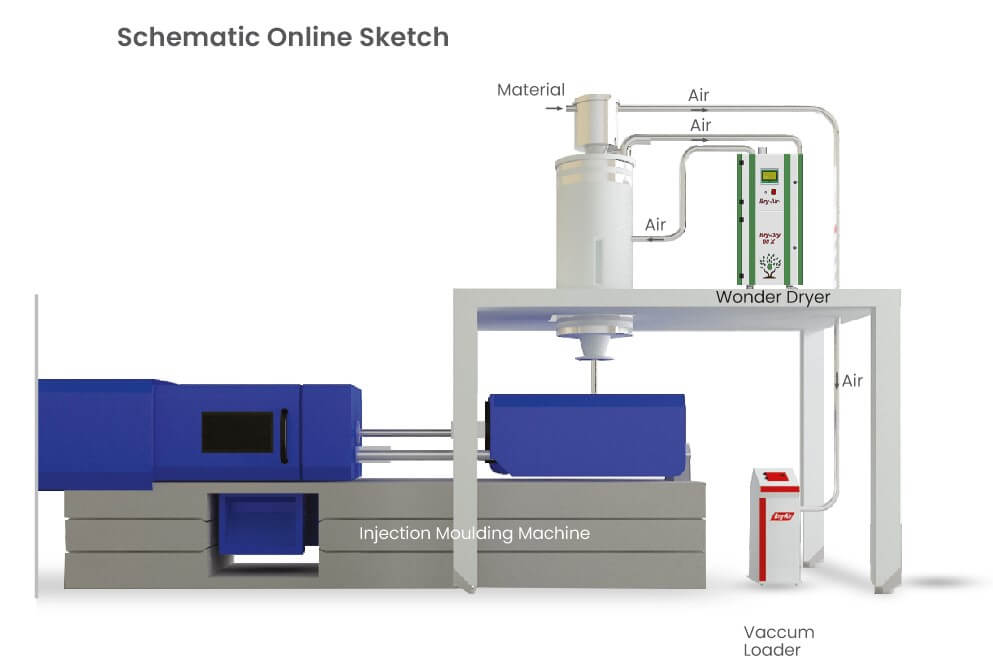
Desiccant dryers use moisture-attracting materials to remove water vapour from air. The resulting dry air is heated to the required process temperature and circulated through a hopper containing plastic resin.
As the dry air passes through the pellets, moisture transfers from the resin into the air stream. The moisture-laden air is then handled by the drying system according to its design. The desiccant material is regenerated to remove collected moisture, allowing the system to continue drying.
This technology is particularly useful for hygroscopic plastics that absorb moisture internally. Unlike basic hot-air drying, which may primarily remove surface moisture, desiccant drying can provide the low-moisture air conditions needed for more thorough drying of suitable polymers.
Understanding Dew Point
Dew point indicates the temperature at which water vapour in air begins to condense under the relevant pressure conditions. In industrial drying, a lower dew point generally indicates drier air.
Maintaining a sufficiently low dew point encourages moisture to migrate from plastic pellets into the surrounding process air. The exact requirement depends on the resin grade, initial moisture content, desired final moisture level, and processing method.
Bry-Air’s Wonder Dryer uses honeycomb rotor technology and is designed to deliver a dew point of -40°C or lower under specified operating conditions. The manufacturer’s published information also describes an option for achieving lower dew points with precooling. Actual performance depends on the selected configuration and operating conditions.
What Features Should Manufacturers Consider When Selecting a Dryer?
Drying Capacity and Material Throughput
Drying equipment must provide enough properly conditioned air to meet the production line’s material consumption. A system with insufficient capacity may struggle to maintain the required drying conditions, while an unnecessarily large system can increase equipment and operating costs.
Manufacturers should calculate their typical and peak resin consumption, taking account of the number of machines being supplied, the material type, and the required residence time in the drying hopper.
Bry-Air lists Wonder Dryer models with process airflow capacities ranging from 30 to 3,500 cubic metres per hour. Choosing an appropriate model requires a technical assessment of the actual application rather than relying on airflow capacity alone.
Temperature and Drying Time
Each polymer has specific drying requirements. Temperature and duration should be selected according to the resin manufacturer’s technical data rather than applying the same settings to every material.
Insufficient drying time may leave moisture in the pellets, while excessive heat or prolonged exposure can damage some materials. Manufacturers should also consider hopper design, airflow distribution, pellet size, and the rate at which resin moves through the system.
A documented drying procedure helps operators maintain the required settings when materials, production volumes, or processing conditions change.
Energy Efficiency and Installation Requirements
Drying equipment can operate for extended periods, making energy efficiency an important factor in operating costs. Manufacturers should evaluate the complete system, including heaters, blowers, regeneration requirements, cooling utilities, maintenance, and expected production hours.
Bry-Air describes its Wonder Dryer as a waterless solution that eliminates the need for a chiller or heat exchanger and associated pipelines in its specified configuration. The company also advertises potential running-cost reductions of up to 40%. These savings are manufacturer-stated figures and should be assessed against the existing system, local energy costs, and actual operating conditions.
How Can a Plastic Pellet Dryer Improve Process Efficiency?
Maintaining Material Quality Before Processing
Resin must reach the required moisture level before it enters the processing machine. A suitable plastic pellet dryer helps provide the dry-air conditions needed to prepare moisture-sensitive materials consistently.
Manufacturers should verify that the selected dryer can handle the resin’s moisture load and required throughput. They should also protect dried pellets from reabsorbing moisture during transfer and storage. Poorly sealed containers, exposed hoppers, and humid conveying air can undermine drying performance even when the dryer itself is operating correctly.
Coordinating drying, conveying, and material storage helps maintain the required moisture condition throughout production.
Reducing Waste and Unplanned Interruptions
Moisture-related defects can lead to material waste, additional inspection, machine interruptions, and inconsistent output. Reliable drying can help reduce these avoidable problems when moisture is a contributing factor.
Manufacturers can evaluate performance by tracking reject rates, defect frequency, material consumption, downtime, and energy usage. Comparing these measurements before and after process improvements provides a more objective assessment than relying on equipment specifications alone.
Supporting Preventive Maintenance
Regular maintenance is necessary to preserve drying performance. Filters should be inspected and replaced according to the equipment manufacturer’s recommendations. Airflow, temperature, dew point, seals, and control functions should also be checked as part of a planned maintenance schedule.
Where the equipment includes electronic monitoring and fault alerts, operators should use these features to identify abnormal conditions and investigate them promptly. Maintaining accurate operating records helps identify recurring issues and supports better production planning.
Why Choose an Application-Specific Plastic Drying Solution?
No single dryer configuration is ideal for every plastic processing application. The correct choice depends on resin characteristics, required moisture levels, production throughput, available space, utility requirements, and operating costs.
Bry-Air develops industrial moisture-control and drying solutions, including the Wonder Dryer for plastic processing. Its published product information highlights self-contained construction, honeycomb rotor technology, portability, and waterless operation.
Before purchasing equipment, manufacturers should confirm the resin specifications, target dew point, drying temperature, required capacity, and available installation space. They should also evaluate maintenance access, controls, energy consumption, and compatibility with existing processing equipment. Technical consultation can help determine whether a proposed system is suitable for the intended material and operating conditions.
Conclusion
A properly selected plastic drying system is essential for controlling moisture, protecting polymer properties, and maintaining consistent manufacturing quality. Effective drying can help reduce moisture-related surface defects, support reliable processing, and limit avoidable production waste.
Manufacturers should assess resin type, drying temperature, residence time, dew point, airflow, and throughput before selecting equipment. They should also consider energy efficiency, maintenance requirements, and the risk of moisture reabsorption during material handling.
An application-specific solution, supported by correct operating procedures and regular performance monitoring, can improve production consistency while helping manage operating costs. To discuss your plastic resin drying requirements and explore suitable equipment options, visit Bry-Air’s Contact Us page.